Kenneth Miller is the Peter Taylor Professor of Neuroscience, co-Director of the Center for Theoretical Neuroscience, and co-Director of the Neurobiology and Behavior Graduate Program at Columbia University. He received his B.A. from Reed College, his M.S. and Ph.D. (with distinction) from Stanford University, and completed his postdoctoral work at UCSF and Caltech. He is a founding member of the editorial board of Journal of Computational Neuroscience and has served as faculty for many years at various summer schools in Theoretical and Computational Neuroscience. He received the Swartz Prize in Theoretical and Computational Neuroscience given by the Society for Neuroscience, and has also been recipient of the Alfred P. Sloan Research Fellowship, Searle Scholar’s Award, and National Science Foundation Graduate Fellowship.
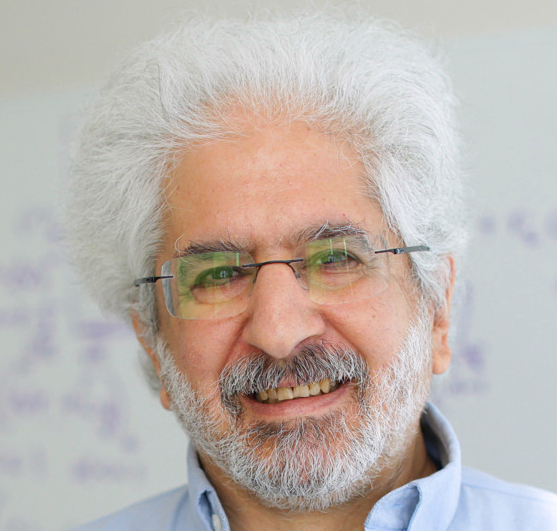
Kenneth Miller
Professor of Neuroscience, Department of Physiology and Director, Center for Theoretical Biology, Columbia University
Participant In These Roundtable Discussions
Sat
Sep 15th
2012
Sep 15th
2012
Watch
What Can Mathematics Teach Us About Mind/Brain?
Philosophy meets mathematics meets neuroscience in this roundtable investigating how cutting-edge mathematical models are elucidating the computational rules encoding brain functions and the implications for a deeper understanding of mind. Free and open to the public.
Sat
Feb 22nd
2014
Feb 22nd
2014
Watch
Biology of Mind
What is mind? Is it a property attributable to biological functionality alone, and, in particular, arising from the morphology of the mammalian brain and/or the influence of that animal’s body? How far down the evolutionary scale can we apply terms like cognition, consciousness, and intelligence? Are we capable of engineering artificial minds?
Sat
Feb 10th
2018
Feb 10th
2018
Watch
Mind Matters: Past, Present, and Future
From Xenophanes’ 6th c. BCE theory of divine intellection imbuing, comprehending, and organizing the cosmos, through Nicholas of Cusa’s 15th c. definition of mind as “the limit and measure of all things,” through Hume and his Enlightenment kin’s aspiration to be the “Newton of the mind,” to the naturalized explanations of contemporary cognitive science, Western... read more! »
Sat
Jan 19th
2019
Jan 19th
2019
Watch
Math models Mind
If a biologist were asked for a single word that would appropriately point to the essence and substance of biology, the word might be Life. It stands for the essential unity of that subject despite the enormous range of different interests of biologists—from proteins to the behavior of elephants to medical applications. Is there an... read more! »
Sat
May 11th
2024
May 11th
2024
Watch
Synthetic Consciousness: Seeing and Believing
This roundtable explores the intricate relationship between vision and attention, the role of vision in our perception of truth and falsehood, and the implications of these concepts on our understanding of animal consciousness, sensory perception, and cultural evolution.